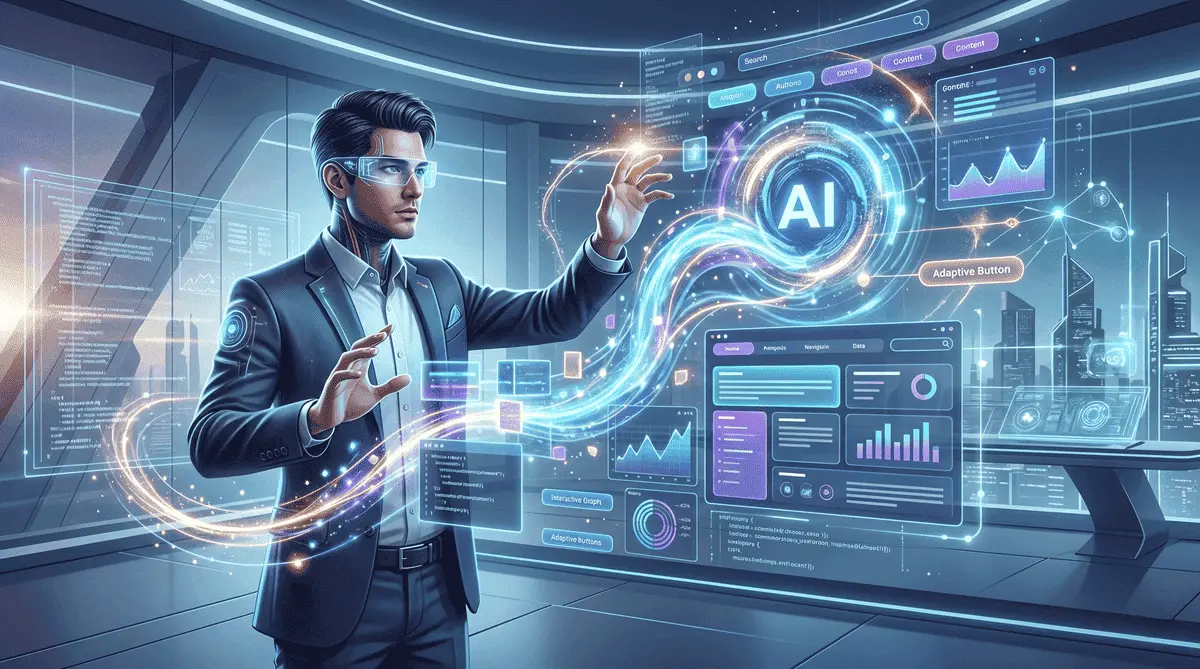
The Future of Web Design: Generative UI and What Changes for Clients
Until recently, Artificial Intelligence in the digital world was primarily seen as a “stochastic parrot” capable of writing blog texts or generating images. Today, the paradigm has shifted much higher: we are entering the era of Generative UI (Generative User Interface).
What happens when a web interface is no longer rigidly designed by a programmer, but is dynamically assembled in real-time by AI based on what the user is trying to do? The rules of the game change, both for those who develop and those who commission a project.
What Is Already Possible Today
We are not talking about science fiction. Modern tools and frameworks (like Vercel’s v0 or AI integrations in modern React stacks) already allow developers to generate complex components starting from a simple text prompt.
But the real revolution is on the client-side. Imagine a management system or an e-commerce platform where:
- The user types: “Show me last month’s sales filtered by the Marche region, and make it a pie chart”.
- The website, instead of showing a pre-built static page, generates the interface in real-time: it extracts the data, draws the chart, and creates a temporary dashboard tailored precisely to that specific request.
The interface becomes liquid. It adapts to the user’s intent.
What Changes for the Developer (From Bricklayer to Architect)
If AI can write the HTML and CSS code for a button or a table in seconds, is the web developer’s role dead? On the contrary, it evolves drastically.
Today, a developer’s value no longer lies in “pressing keys” to align pixels on a screen. The role becomes that of a Systems Architect. My job is no longer writing repetitive code (boilerplate), but:
- Orchestrating AI: Guiding generative models to produce secure and accessible code.
- Integration and Security: AI doesn’t know how to protect your database’s sensitive data or how to securely connect your payment gateway.
- Performance Optimization: AI tends to generate redundant code. The human eye is needed to clean it up (using architectures like Astro) and ensure instant loading times.
What Changes for You (The Client)
This technological transition brings huge tangible benefits for SMEs and entrepreneurs who decide to invest in the digital space:
- Instant Prototyping: The time it takes to see a first draft (mockup) of your site or app is reduced from weeks to days. This allows us to quickly test ideas on the market (Fail fast, learn faster).
- Cost Reduction on Low-Value Tasks: If it takes me half the time to build a standard interface thanks to AI, that budget isn’t lost: it’s reinvested where it truly matters.
- More Budget for Integrated Strategy: Instead of paying for “code writing”, you are investing in business logic. The budget shifts from technical manual labor to conversion rate optimization (CRO), advanced SEO, and personalization of the user experience.
How to Prepare
Generative UI is destroying the low-end web design market (the famous pre-made sites for a few hundred dollars). Why pay someone to assemble a mediocre template when an AI can do it for free and better?
However, AI does not know your market, it does not know how to listen to your customers’ frustrations, and it lacks critical thinking. Relying on an expert technological consultant means leveraging these new tools to build solid, scalable platforms that are, above all, designed to solve your real business problems. The future is not “Human vs. AI”, but “Human with AI” against those who stubbornly work like they did ten years ago.