From React to Astro: When (and Why) to Migrate Your Frontend
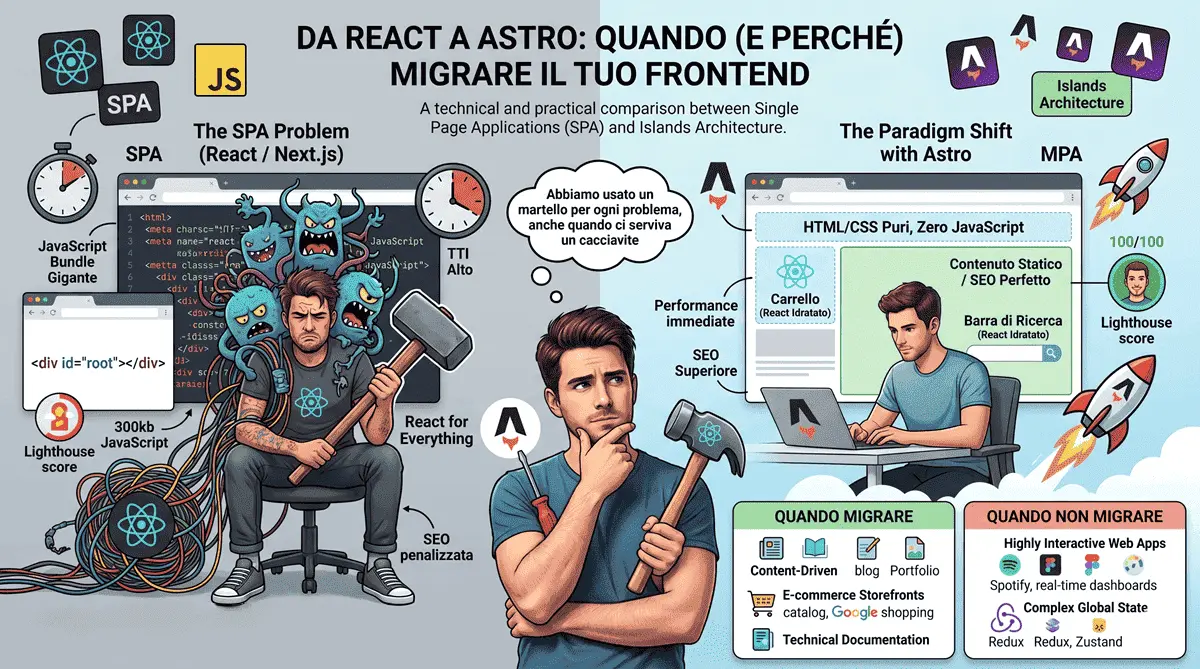
In recent years, React has become the undisputed king of frontend development. It has forever changed the way we build user interfaces. However, as often happens in the tech industry, we started using a hammer for every problem, even when we needed a screwdriver.
We built simple blogs, landing pages, and corporate sites as if they were complex Single Page Applications (SPAs). The result? Slow websites, massive JavaScript bundles, and penalized SEO.
Today, I want to technically analyze when it makes sense to take your React frontend and migrate it to Astro, what you gain, and what you have to give up.
The SPA Problem (React / Next.js)
In a pure React application, the server sends the browser a practically empty HTML file (the famous <div id="root"></div>) accompanied by a gigantic JavaScript file.
The client’s browser must download, parse, and execute all that code to finally “draw” the interface (Client-Side Rendering) and make it interactive (Hydration).
- The cost: High Time to Interactive (TTI) and a massive strain on the CPUs of less powerful mobile devices.
- The paradox: We are forcing users to download 300kb of JavaScript just to show them static “About Us” text.
The Paradigm Shift with Astro
Astro solves this problem by going back to basics (Multi-Page Applications), but with modern superpowers. By default, Astro strips out all the code and sends the browser only pure HTML and CSS. Zero JavaScript.
The real stroke of genius is the Islands Architecture. You don’t have to abandon React. If you need a highly interactive component (like an e-commerce cart or a complex search bar), you can use your existing React code and tell Astro to “hydrate” only that specific island, leaving the rest of the page static.
When (and Why) to Migrate to Astro
Migration makes absolute sense (and brings incredible ROI in terms of conversions and SEO) in these cases:
- Content-Driven Sites: Blogs, editorial sites, portfolios, and corporate landing pages. Here, content is king, and reading speed is everything.
- E-commerce (Storefronts): Product catalogs must index perfectly on Google and load in milliseconds. You can keep the checkout in React (as an island) and everything else in static Astro.
- Technical Documentation: Where users are looking for fast answers without having to wait for a complex routing application to load.
What do you gain?
- Instant Performance: Going from Lighthouse scores of 60/100 to 100/100 is the norm, not the exception.
- Superior SEO: Google loves clean, instant HTML.
- Less code to maintain: Zero complex client-side routing libraries.
When NOT to Migrate (The Trade-offs)
Astro is not a universal magic wand. There are cases where React (or Next.js) remains the only sensible choice:
- Highly Interactive Web Apps: Think Spotify clones, real-time financial dashboards, tools like Figma or Notion. In these cases, the interface changes constantly without changing the page.
- Complex Global State: If your application relies heavily on Redux, Zustand, or massive state passing between dozens of components simultaneously, Astro’s Islands architecture will become a hurdle, not a help.
Conclusion
Astro isn’t killing React; it’s saving it from itself. It allows us to use React only where it’s truly needed, eliminating the “performance debt” for everything else. Migrating to Astro means putting the end-user’s experience (and their data plan) back at the center of the development process.