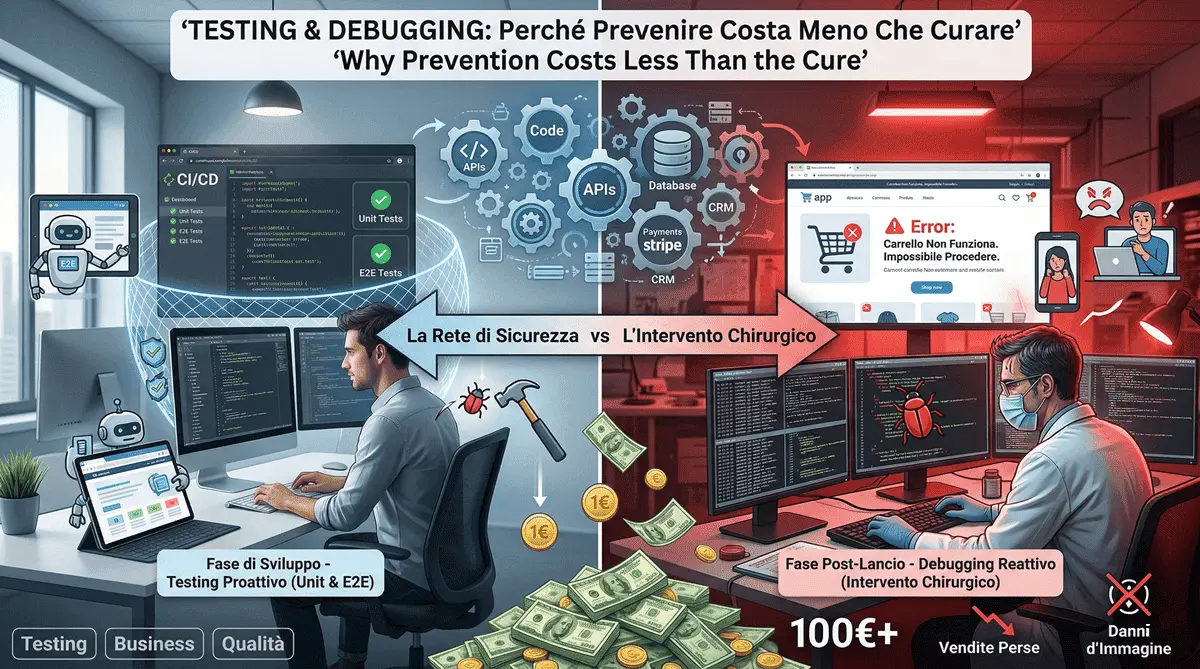
Testing & Debugging: Why Prevention Costs Less Than the Cure
There is a very well-known, unwritten rule in software engineering: fixing a bug during the design or development phase costs $1. Fixing it when the software is already public and being used by clients can cost $100 (or much more, if we calculate lost sales and brand damage).
Often, when planning a digital project (whether it’s an e-commerce site, a corporate ERP, or a web app), the Testing and Debugging phase is perceived by non-experts as an “extra,” an annoying slowdown before the launch. In reality, it is the critical phase to guarantee that your investment won’t collapse at its first real-world trial.
The Myth of the “Perfect Developer”
A modern web application is not a simple text document. It is a complex ecosystem made up of thousands of lines of code, third-party libraries, databases, and external APIs (like Stripe for payments or a CRM for emails) that must communicate with each other in fractions of a second.
In a mechanism with so many moving parts, unexpected issues are not a remote possibility: they are a certainty. The true value of a professional lies not in the illusion of never making mistakes, but in having a rigorous, scientific method to intercept them before the end user does.
The Difference Between Testing and Debugging
Although they are often used synonymously in common language, they are two profoundly different, yet complementary, phases:
1. Testing (The Safety Net)
Testing is a proactive process. I don’t wait for a user to report that the shopping cart isn’t working; I write programs that test my own code.
- Unit Tests: I verify that a single gear works (e.g., “Is the VAT calculation in the cart correct?”).
- End-to-End (E2E) Tests: I simulate the behavior of a real user, instructing a bot to navigate the site, add a product to the cart, and complete the checkout. If the code passes these automated tests with every update, I know the architecture is solid.
2. Debugging (The Surgical Intervention)
Debugging is a reactive and investigative process. It begins when, inevitably, an unexpected problem (a bug) manifests itself. It’s not about “trial and error,” changing lines of code at random and hoping the problem disappears. Good debugging requires isolating the faulty portion of code, analyzing server logs, reproducing the error in a safe environment, and finally, applying a surgical fix to the root of the problem.
The (Financial) Benefits for Your Business
Why should you be happy to see hours dedicated to testing in your quote?
- Protects Your Conversions: A “Submit Request” button that can’t be clicked on Safari, or a contact form that errors out on Android devices, means lost leads and money left on the table. Cross-testing (cross-browser and multi-device) eliminates this risk.
- Guarantees Safe Scalability: When your business grows and you ask me to add a new, complex feature to the platform, my “safety net” of automated tests will ensure that the new code doesn’t break the old features that were already working perfectly (the famous regressions).
- Lowers Maintenance Costs: Untested code generates “technical debt”. Every future modification will take three times as long because the developer will be working blind. With tests, future modifications are fast and cost-effective.
- Safeguards Your Reputation: Buggy software that freezes or shows incomprehensible error messages immediately projects an image of poor professionalism. A smooth user experience, on the other hand, builds trust in your brand.
Conclusion
Testing and debugging are the invisible foundations of your digital project. Relying on a development process that integrates these practices from day one means you can sleep soundly after the “Go Live,” with the certainty that your platform is ready to handle real traffic without nasty surprises.