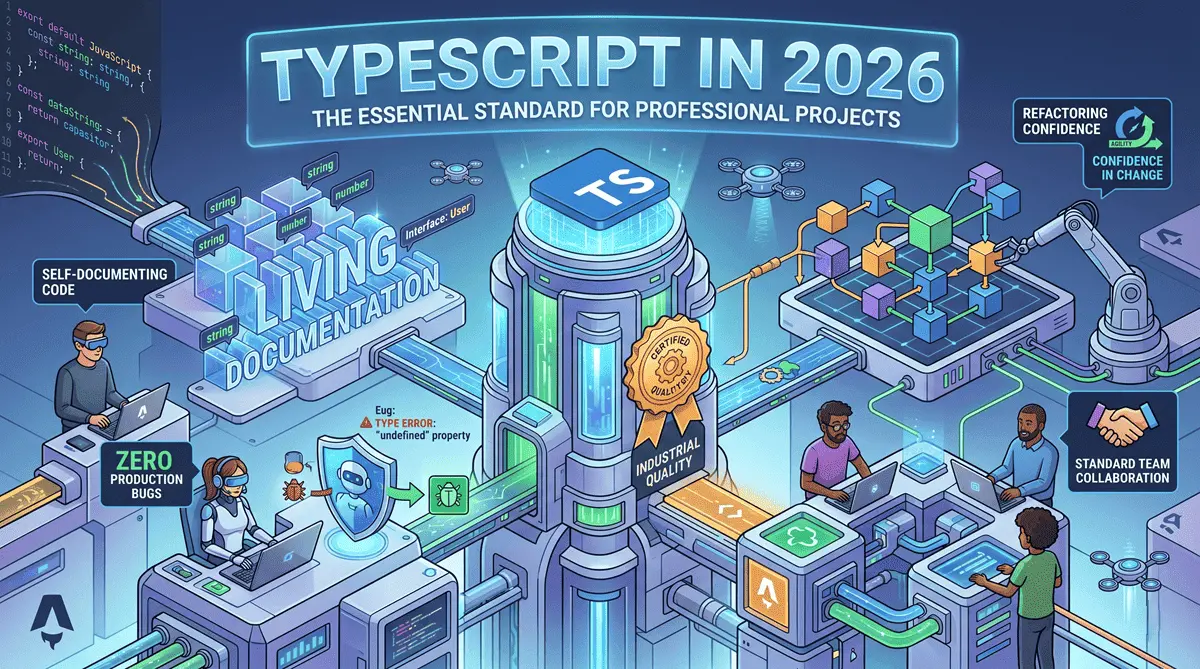
TypeScript in 2026: Why Every Project Should Use It
If 2025 was the year of consolidation, 2026 has established an irrefutable truth in the software development world: starting a professional project today without TypeScript is a risk no company should take.
TypeScript is often perceived by non-experts as a “hurdle” that slows down coding by adding rigid rules. In reality, it’s the exact opposite: it is the best ally for anyone who wants to deliver solid, scalable software that is, above all, free of nasty surprises once it goes into production.
Beyond Basic Types: Code That Explains Itself
Many think TypeScript is just about saying a variable is a “string” or a “number.” But in 2026, its power lies in its ability to model business logic flawlessly.
Thanks to TypeScript, code becomes self-documenting. If a collaborator (or the developer themselves six months later) reopens a module, they don’t have to guess what data to expect. TypeScript “screams” if you try to use a property that doesn’t exist or if you forget to handle an edge case. This fundamentally eliminates the need for piles of external documentation that no one reads: the code is the documentation.
Reducing Production Bugs
Most errors in traditional JavaScript software stem from small oversights: an undefined variable, a function called with the wrong arguments, or data arriving from the database in an unexpected format.
TypeScript catches these errors while you are writing. It’s like having an expert reviewer sitting next to you, correcting you before you even hit “save.” For a business, this translates to:
- Less Downtime: The site or app doesn’t suddenly break due to a trivial error.
- Cost Savings: Fixing a bug before release costs infinitely less than doing it when customers are already using the service.
Refactoring Is No Longer Scary
In a growing project, there always comes a time when you need to change a part of the code to improve it or add features (so-called refactoring). Without TypeScript, this is a high-risk operation: change one thing here, and something invisible breaks on the other side of the software.
With TypeScript, you can rename functions, change data structures, or move modules with extreme confidence. The compiler will instantly flag every single point in the project that needs updating to reflect the change. It is a guarantee of agility: you can evolve your software at the speed of your business.
A Language for Collaboration
If you work in a team, or if you expect your project to be handled by other developers in the future, TypeScript is essential. It standardizes how data flows through the application, drastically reducing “handover” time. A new developer can become productive on your code in half the time.
Conclusion
In 2026, TypeScript is no longer an “option” for geeks: it is an industrial quality standard. Using it in my projects (like this portfolio built with Astro and TypeScript) is my promise of professionalism to my clients. It means delivering a product that is not just “beautiful on the outside” but structurally sound and ready to stand the test of time.