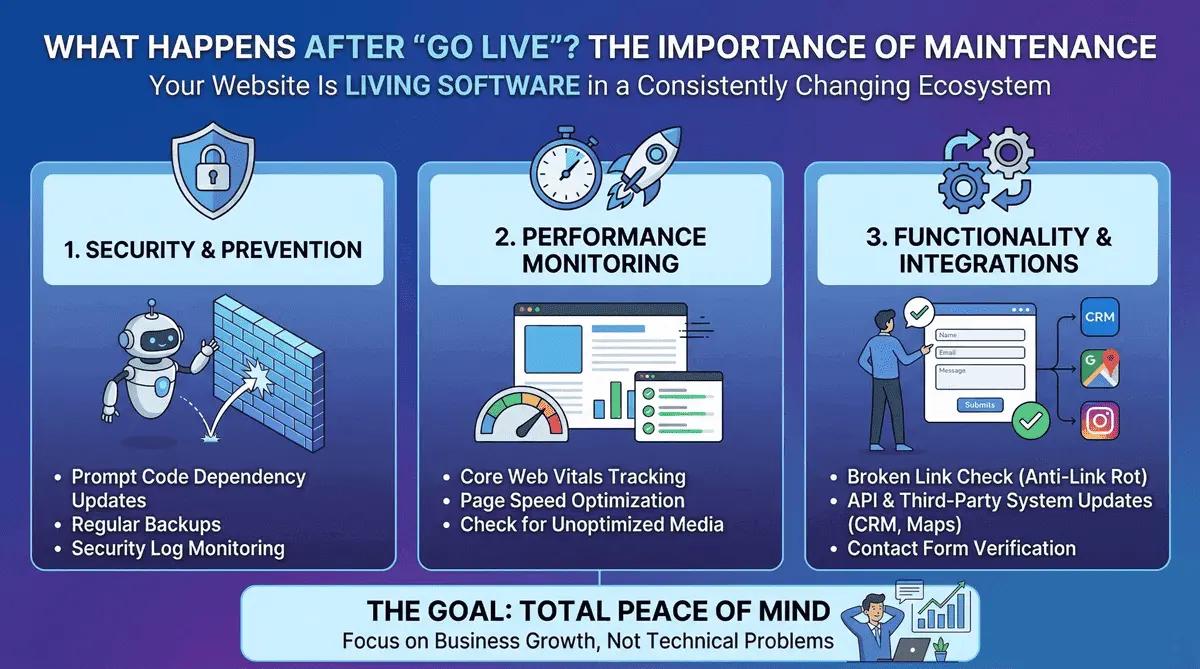
What Happens After 'Go Live'? The Importance of Maintenance
The “Go Live” moment – the official launch of a website – is always the exciting culmination of weeks of analysis, design, and development. We toast, post on social media, and often, clients breathe a sigh of relief thinking: “Great, that’s done. We don’t have to think about it for the next 5 years”.
This is the most common and, unfortunately, most costly misconception in the digital world. People tend to treat a website like an editorial product, similar to a printed brochure or a painting to hang on the wall.
In reality, a website is living software operating in an ecosystem that is in constant, and very rapid, evolution.
The Illusion of Immutability
Imagine buying a brand new sports car. You drive it every day but decide to never get it serviced, never change the oil, and ignore the warning lights on the dashboard. How long do you think it will last before leaving you stranded (probably at the worst possible time)? The exact same thing happens with your website.
Even if your code doesn’t change, the web around your site changes every single day:
- Browsers (Chrome, Safari, Firefox) release continuous updates that can alter how code is rendered.
- Google updates its algorithms, changing the rules for staying on the first page.
- Third-party technologies (APIs) evolve or become deprecated.
The Three Pillars of Professional Maintenance
Having a maintenance plan doesn’t simply mean “fixing a text typo every now and then”. It means protecting your investment and ensuring it continues to generate leads and sales. Here is what it actually covers:
1. Security and Prevention (The Invisible Enemy)
One of the phrases I hear most often is: “Why would a hacker attack my small corporate site?”. The truth is, it’s not a personal attack. The web is constantly scanned by automated bots looking for vulnerable servers. They don’t want to steal your company data; they want to use your server to send millions of spam emails or host illicit files. Maintenance involves promptly updating code dependencies, monitoring security logs, and managing regular backups. If a disaster happens, you need to be able to restore the site in 10 minutes, not a week.
2. Performance Monitoring
A site that loads in 1 second at launch could slow down drastically over time. Why? Maybe an employee uploaded heavy 5MB images in the blog section, or an external tracking script stopped responding quickly. Proactive monitoring allows us to catch these performance drops before your customers (and Google) notice, keeping your Core Web Vitals perfect at all times.
3. Functionality and “Link Rot”
Modern sites are not isolated islands. They often communicate with the outside world: a contact form linked to your CRM, a Google Map, an Instagram feed, a newsletter subscription system. These connections (APIs) change over time. Without maintenance, you might wake up one day to discover that your contact form stopped working a month ago, and you’ve lost dozens of potential clients without even knowing it.
Conclusion: Peace of Mind Has a Value
Fixing a site that has been compromised by a cyberattack or having to rebuild it from scratch because the technologies have become hopelessly obsolete costs infinitely more than a regular maintenance retainer.
The goal of a maintenance contract is to offer you total peace of mind. Your job is to focus on growing your company; my job is to make sure your “digital storefront” is always open, fast, secure, and ready to convert every single visitor.