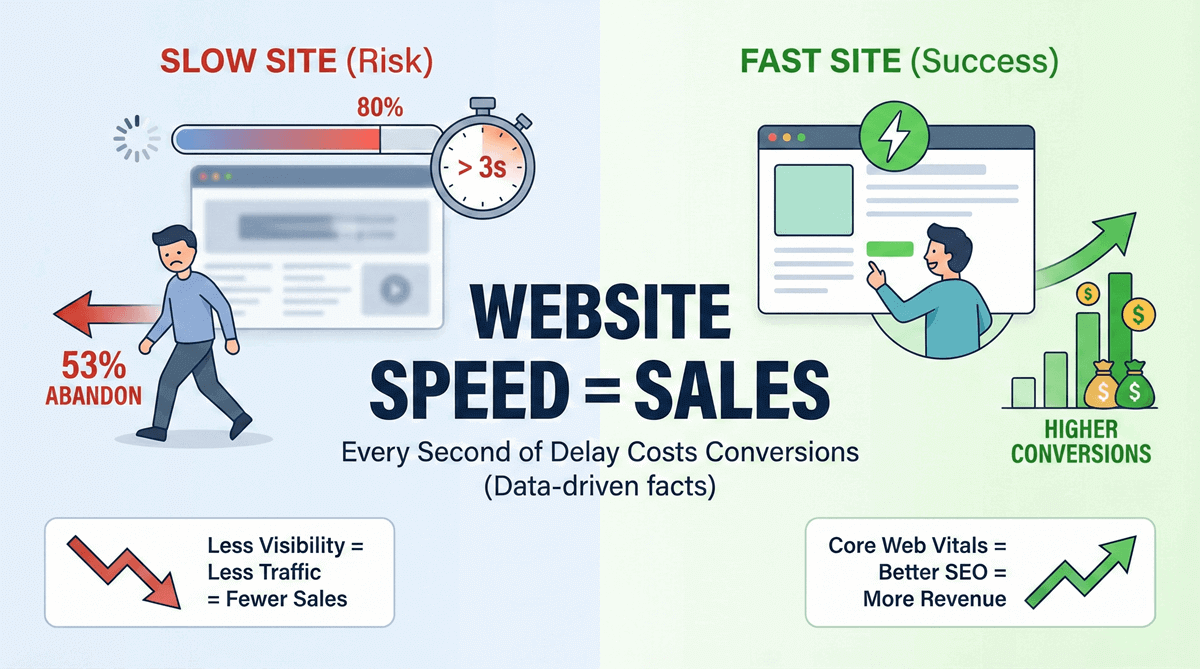
Why Website Speed Influences Your Sales
We are in the age of digital impatience. According to established studies by Google and Amazon, every second of delay in page loading costs a significant loss in conversions. Specifically, if a mobile page takes more than 3 seconds to load, 53% of users abandon the site before even seeing the logo.
It doesn’t matter how beautiful your design is or how affordable your product is: if the user can’t see it immediately, they leave.
Core Web Vitals and Visibility
Speed is not just a matter of User Experience (UX); it has become a crucial technical factor. Google uses Core Web Vitals (LCP, FID, CLS) as metrics to decide who gets on the first page. A slow site is actively penalized in search results.
- Less visibility = Less organic traffic.
- Less traffic = Fewer sales opportunities. It is a simple but ruthless equation.
The “Culprits” of Slowness
Why are many sites slow? Often the problems are structural and invisible to the naked eye:
- Giant Images: Photos uploaded directly from the camera (5-10MB files) instead of modern compressed formats like
.webpor.avif. - JavaScript Bloatware: Excessive use of tracking libraries, social widgets, or chatbots that block the rendering of the main page.
- Cheap Hosting: Shared servers that fail to handle traffic spikes.
The Technical Solution
Optimizing a site isn’t magic; it’s engineering. In my workflow, I apply precise strategies to guarantee instant speed:
- Lazy Loading: Loading images only when the user scrolls down to that point.
- Minification: Minimizing the weight of CSS and JavaScript files.
- Static Architecture: Using generators like Astro allows serving pre-built HTML pages, eliminating database wait times.
Speed is the first form of respect for your customers’ time. A fast site communicates professionalism and efficiency even before the user reads a single word.