Custom Code vs WordPress: What to Choose in 2026?
In 2026, the question is no longer “do I need a website?”, but “what kind of infrastructure does my business need?”. Often, the automatic answer is WordPress. Don’t get me wrong: WordPress powers nearly 40% of the web and is a fantastic tool for editorial blogs or news outlets.
However, when we talk about corporate sites, advanced portfolios, or platforms designed to convert visitors into customers, the story changes drastically.
The Paradox of “Ease”
WordPress was born as a generic platform. Its strength is its weakness: to do anything specific, you need a plugin.
- Need SEO? Plugin.
- Need a secure contact form? Plugin.
- Need to optimize images? Another plugin.
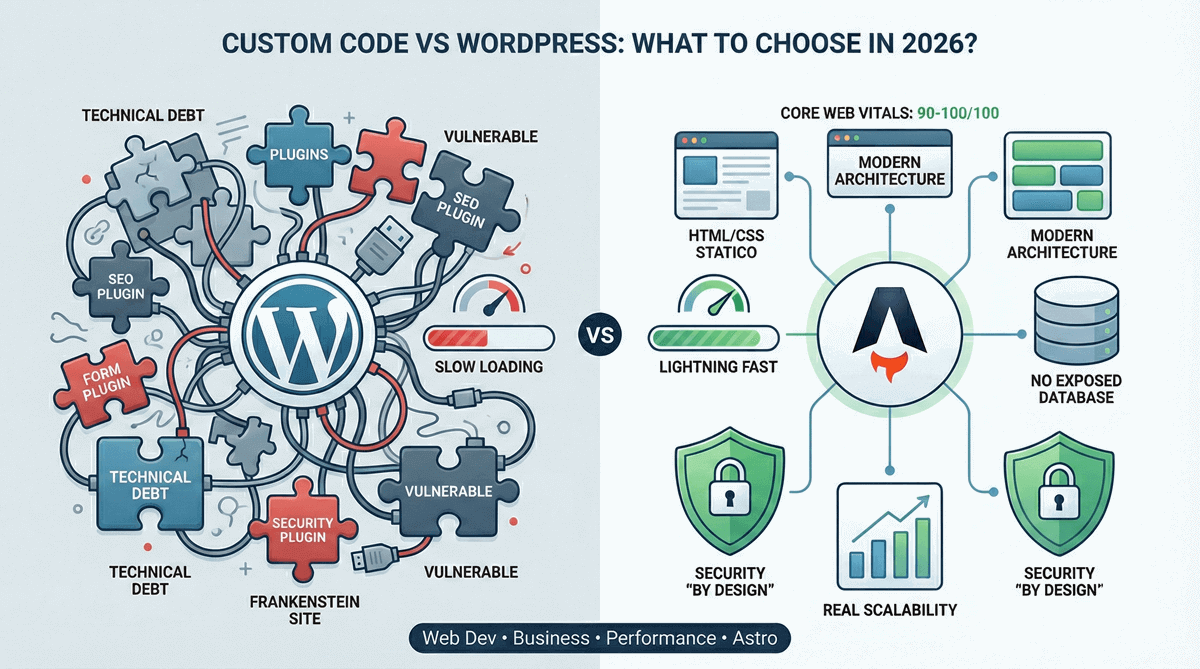
The result is often a “Frankenstein” website: heavy to load, full of unused code, and vulnerable. Every plugin is a potential backdoor for hackers if not constantly updated. This is called technical debt, and you pay for it with slowness.
The Custom Choice (The Modern Approach)
Developing a custom site today (or Custom Code) doesn’t mean reinventing the wheel by writing incomprehensible code. It means using modern architectures, like Astro (the same framework I use for this portfolio), to build exactly what is needed.
Here are the tangible benefits of this approach:
1. Speed and Core Web Vitals
A static or hybrid site loads only the HTML and CSS strictly necessary for that specific page. No database to query, no heavy themes loading in the background. Google rewards this efficiency: a custom site has a head start in reaching scores of 90-100/100 on Core Web Vitals, which are essential for SEO.
2. Security “By Design”
Without a database directly exposed to the public and without third-party plugins of dubious origin, the attack surface is reduced by 90%. It is almost impossible to “hack” a site that is, essentially, a set of ultra-optimized static files.
3. Real Scalability
With WordPress, you are bound by the limits of the theme you bought. With a custom site, the design and functionality grow with your company. Do you want to integrate a CRM tomorrow? It can be done. Do you want to completely change the homepage layout? You don’t have to throw the whole site away.
The Verdict
If your goal is to have an amateur blog to update three times a day with no design requirements, WordPress is fine. But if your site needs to be your company’s digital business card, it must be as fast as lightning and as secure as a vault. In that case, custom development is an investment that pays for itself over time by eliminating continuous maintenance costs.