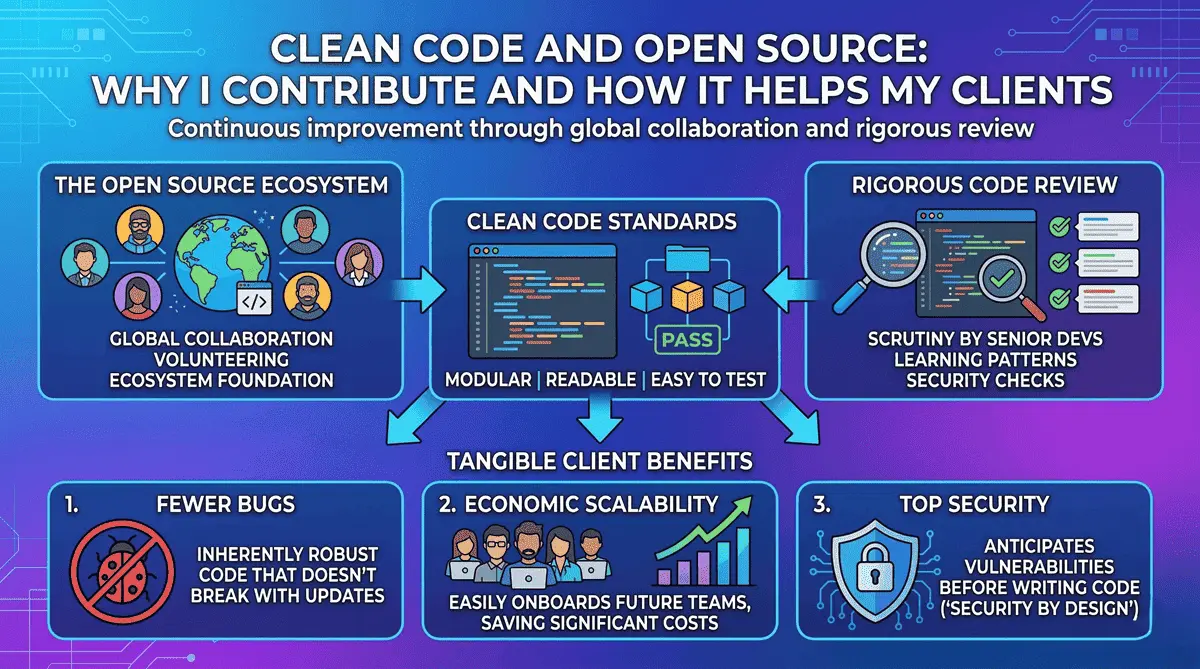
Clean Code and Open Source: Why I Contribute and How It Helps My Clients
Often, when I talk to clients or people outside the tech industry, I get asked a recurring question: “Why do you spend your free time writing code for free for Open Source projects?”
It’s a legitimate question. In the traditional business world, giving away your work seems counterintuitive. But in software development, Open Source is the ecosystem that makes the world go round (literally: the servers, phones, and frameworks we use every day are built on it).
Contributing to these projects isn’t just an act of altruism towards the community. It is a high-intensity “gym” that makes me an infinitely better developer for my clients. Here is why.
The Myth of “As Long As It Works” and Clean Code
There is a massive difference between writing code “that works” and writing Clean Code. Any beginner, after a few tutorials, can hack together a script that makes a menu appear or submits a form.
But code isn’t just read by computers. It is read, modified, and maintained by human beings over the years. Clean Code is code written to be predictable, modular, documented, and easy to test.
In Open Source, if you write messy code (so-called “spaghetti code”), it simply won’t be accepted. You are forced to raise the bar, name variables with surgical precision, and structure your logic so that anyone, from Tokyo to San Francisco, can understand it at a glance.
The Art of the Code Review
When I submit a modification (Pull Request) to an Open Source library or framework, my code is scrutinized by the project’s maintainers. Often, these are top-tier software engineers, senior developers from high-profile open source projects.
Getting a ruthless but constructive Code Review on 50 lines of code is an experience worth more than 10 training courses. You learn more efficient design patterns, discover vulnerabilities you hadn’t thought of, and refine your performance optimization techniques.
The (Real) Benefit for the Client
What does all this have to do with your company’s website or web application? It has everything to do with it.
When a client entrusts me with a project, they aren’t just buying my time. They are benefiting from the fact that my working method has been validated, critiqued, and perfected by the global community. This translates into tangible business advantages:
- Fewer Bugs: Code written with Open Source principles is inherently more robust and less prone to “breaking” with updates.
- Economic Scalability: If your company grows tomorrow and needs to onboard a team of 5 developers onto my code, they can do it in a few hours. If the code were dirty and incomprehensible, they would have to throw everything away and start from scratch (incurring huge costs).
- Top Security: Working in Open Source teaches you to anticipate security flaws before even writing the first line of code (Security by Design approach).
These principles apply directly to two other pillars of software quality: test coverage and debugging (covered in my guide on testing, debugging, and business stability), and rigorous typing (explored in the article on TypeScript and scalable software development in 2026).
Conclusion
Open Source prevents me from getting stuck in my own freelance “bubble”. It forces me to face the best every day, to question my certainties, and to study cutting-edge technologies. And it is exactly this level of quality and excellence that I bring to every single client’s project.
Frequently Asked Questions
What does Clean Code mean in software engineering?
Clean Code refers to writing code that is predictable, highly modular, well-documented, and fully testable, rather than just 'making it work'.
Why do Open Source contributions matter for private clients?
Open Source subjects a developer to rigorous peer reviews by top engineers. This methodology translates into highly secure, robust, and scalable solutions for clients.
How does Clean Code bring economic benefits to businesses?
Clean code is easier to scale and less prone to bugs. Businesses, including small and medium enterprises in the Marche region, save on long-term maintenance costs and future refactoring.
Have a similar project in mind?
If this article gave you useful ideas, I can help you put them into practice on your site or project.
Get a Free Quote