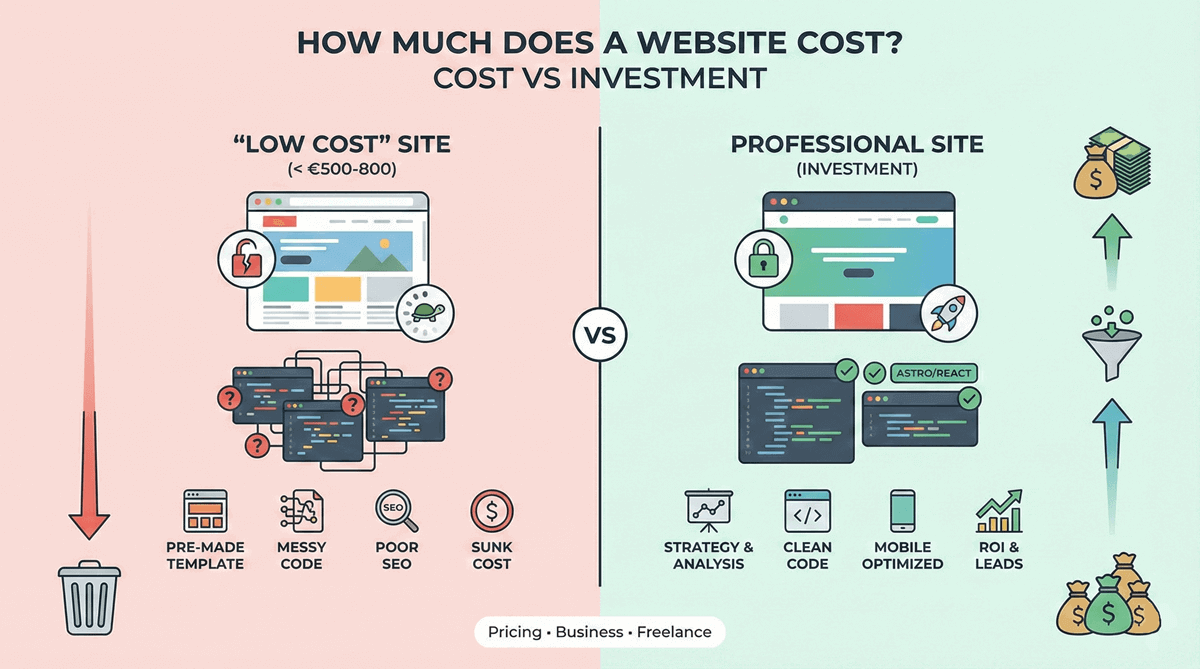
It’s the question every client asks, and rightly so: “How much will it cost?”. Often, however, in the digital market, you face a jungle of quotes: from the cousin who does it for €300 to the agency asking €5,000 for what, on the surface, seems to be the same job. Why is there such a difference?
The truth is, on the web, you are not buying an off-the-shelf product, but an engineering and communication service.
The “Hidden Costs” of Low Cost
A low-cost site (under €500-800) is usually a pre-made template, bought for a few euros and filled with your content without any logic.
- The technical problem: The code is messy and unoptimized. Google will struggle to read and index it.
- The business problem: The design is identical to a thousand other companies. There is no differentiation.
- The result: You spent little, but that site is a “sunk cost.” It won’t bring leads, it won’t convert, and you’ll likely have to rebuild it from scratch within a year.
What Are You Paying for in a Professional Site? (The Investment)
When a professional presents you with a quote, the cost doesn’t just cover the hours of writing code. You are investing in a set of fundamental assets:
- Analysis and Strategy: Before writing a line of code, we need to understand who your ideal client is and how to talk to them. The site must be a sales tool, not a poster. This is the first step of a structured process: if you want to understand how the phases of a custom software or web development project unfold, there’s a dedicated deep dive.
- Technical Performance: Optimizing images, configuring caching, writing clean code (perhaps using technologies like Astro or React) to ensure the site loads in milliseconds. This groundwork also underpins proper indexing through Google Search Console, essential for SEO ranking.
- Mobile Adaptability: It’s not enough for the site to just “shrink” on a phone. The mobile user experience must be designed for touch, with accessible menus and readable text.
- Maintainability: A professional site is built to last. The code is modular, allowing future updates without “breaking” the entire system.
Conclusion: The Price of “Not Working”
A slow, malfunctioning website costs much more than the price you paid the developer: it costs you in lost customers and damaged reputation. In the digital world, the golden rule applies: the bitterness of poor quality remains long after the sweetness of low price is forgotten. Investing in quality today means positioning yourself above the competition tomorrow.
Frequently Asked Questions
Why is there such a large price gap between web developers?
The price difference reflects standard low-cost templates versus engineered, custom-coded strategic platforms built for high performance, deep SEO, and high conversion rates.
What are the hidden costs of cheap websites?
Cheap sites act as a 'sunk cost': they are poorly optimized, slow, generic, and will cost you thousands in lost customers and tarnished brand reputation over time.
Do you provide custom quotes for businesses outside Italy?
Yes. Based in Civitanova Marche, Italy, I also work with clients across Italy and internationally, offering transparent quotes tailored to real business needs and ROI.

Have a similar project in mind?
If this article gave you useful ideas, I can help you put them into practice on your site or project.
Get a Free Quote