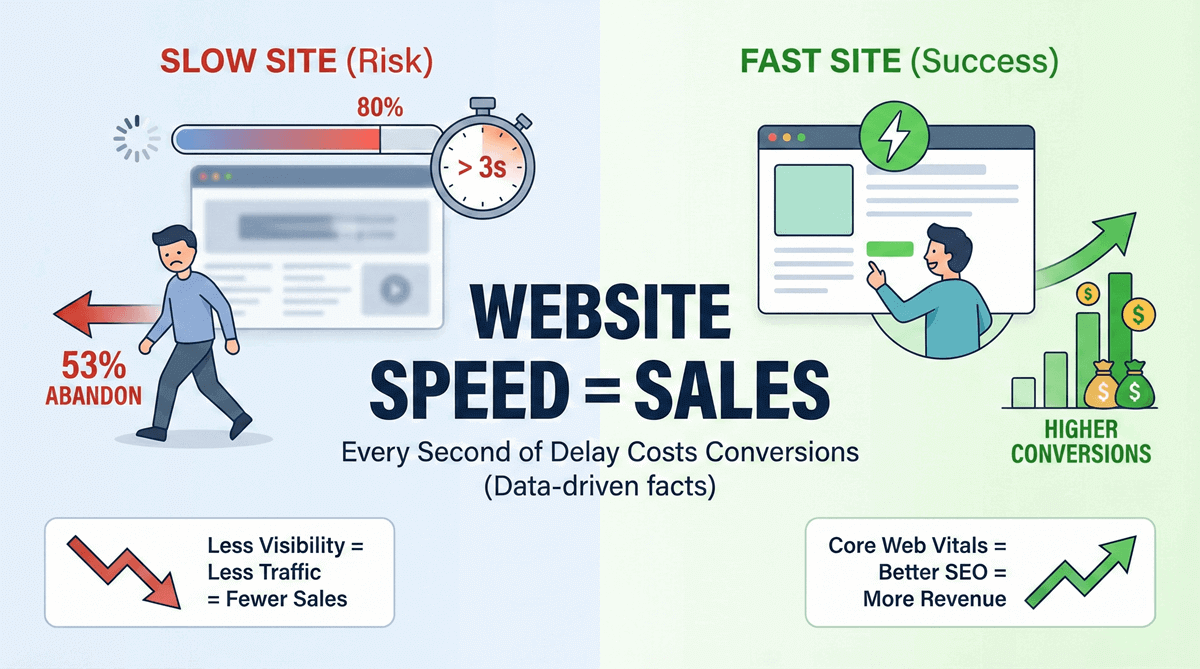
We are in the age of digital impatience. According to established studies by Google and Amazon, every second of delay in page loading costs a significant loss in conversions. Specifically, if a mobile page takes more than 3 seconds to load, 53% of users abandon the site before even seeing the logo.
It doesn’t matter how beautiful your design is or how affordable your product is: if the user can’t see it immediately, they leave.
Core Web Vitals and Visibility
Speed is not just a matter of User Experience (UX); it has become a crucial technical factor. Google uses Core Web Vitals (LCP, FID, CLS) as metrics to decide who gets on the first page. A slow site is actively penalized in search results.
- Less visibility = Less organic traffic.
- Less traffic = Fewer sales opportunities. It is a simple but ruthless equation.
The “Culprits” of Slowness
Why are many sites slow? Often the problems are structural and invisible to the naked eye:
- Giant Images: Photos uploaded directly from the camera (5-10MB files) instead of modern compressed formats like
.webpor.avif. - JavaScript Bloatware: Excessive use of tracking libraries, social widgets, or chatbots that block the rendering of the main page.
- Cheap Hosting: Shared servers that fail to handle traffic spikes.
The Technical Solution
Optimizing a site isn’t magic; it’s engineering. In my workflow, I apply precise strategies to guarantee instant speed:
- Lazy Loading: Loading images only when the user scrolls down to that point.
- Minification: Minimizing the weight of CSS and JavaScript files.
- Static Architecture: Using generators like Astro allows serving pre-built HTML pages, eliminating database wait times.
Speed is the first form of respect for your customers’ time. A fast site communicates professionalism and efficiency even before the user reads a single word.
These technical optimization principles are often tied to the choice of the site’s underlying architecture: I cover this in detail in my guide on custom-coded websites vs WordPress and in the deep dive on Core Web Vitals and technical SEO in 2026.
Frequently Asked Questions
How does slow page loading actively hurt online sales?
Data confirms that any mobile page loading taking beyond 3 seconds incurs a 53% user abandonment rate, directly equating to massive losses in qualified leads and revenue.
Why is speed optimization considered an SEO ranking factor?
Google algorithms actively penalize slow websites because speed defines User Experience. Fast sites dominate the Core Web Vitals assessment, earning prime first-page visibility.
How do you speed up websites for clients in the Marche region and beyond?
Based in Civitanova Marche, Italy, I apply a static architecture with Astro, set up Lazy Loading, and use next-gen image formats to deliver 100/100 performance for clients across Italy and internationally.



Have a similar project in mind?
If this article gave you useful ideas, I can help you put them into practice on your site or project.
Get a Free Quote